My research focuses on making neural networks and large language models more efficient and interpretable. I study how model structure and information flow can guide compression while preserving useful capabilities. My work spans model pruning and knowledge distillation, graph theory-based analysis of neural networks, and explainable AI.
I am also exploring efficient inference in long-horizon settings, particularly how KV cache management can help language models retain useful context over extended interactions within limited memory budgets.
Engineering toolkit Python / C++ · PyTorch / CUDA · Linux / Git / Docker · ROS · TypeScript / Java / SQL
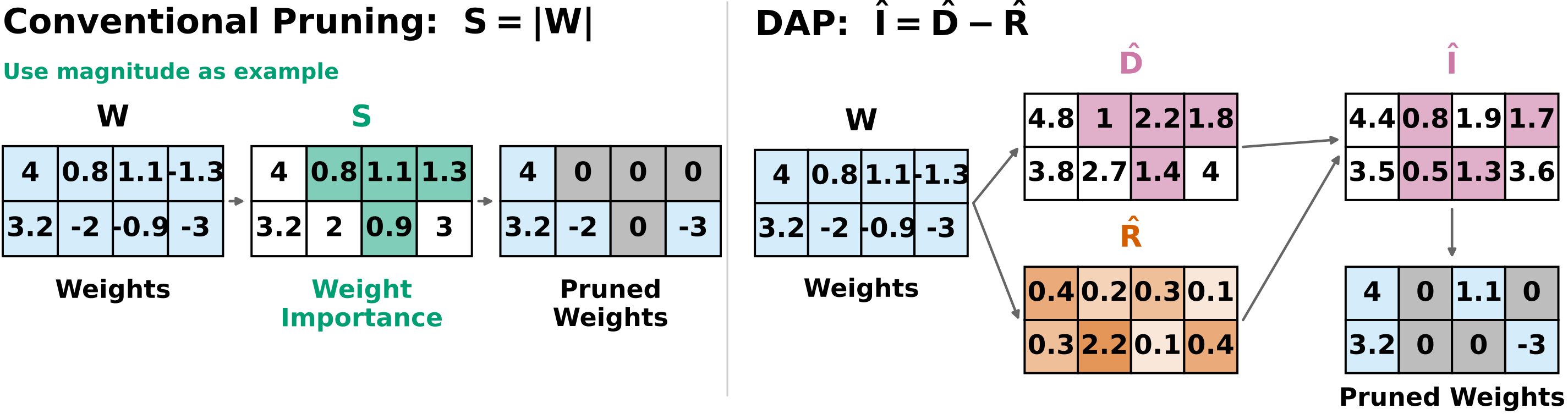
How should we compress a language model when it can learn from a teacher afterward? Pruning typically aims to minimize the immediate damage from removing weights, but the least damaged model is not necessarily the strongest student after distillation. I study how the teacher’s ability to recover that damage should guide what we prune.
DAP accounts for both pruning damage and what distillation can repair. Enlarge figure · Vector PDF
Distillation-Aware Pruning (DAP) is a second-order framework that jointly models immediate pruning damage and recoverability under the intended teacher and distillation procedure. It estimates the damage that distillation cannot repair to guide the design of compressed students.
Experiments on Qwen3-8B and DeepSeek-R1-Distill-Llama-8B show gains of up to 3.9 percentage points in average post-distillation performance over the strongest pruning baseline, under matched sparsity and training budgets.
Manuscript under review at ICLR 2027.
Explainable AI & neuro-symbolic learning
Understanding Neural Networks Through Graph Curvature
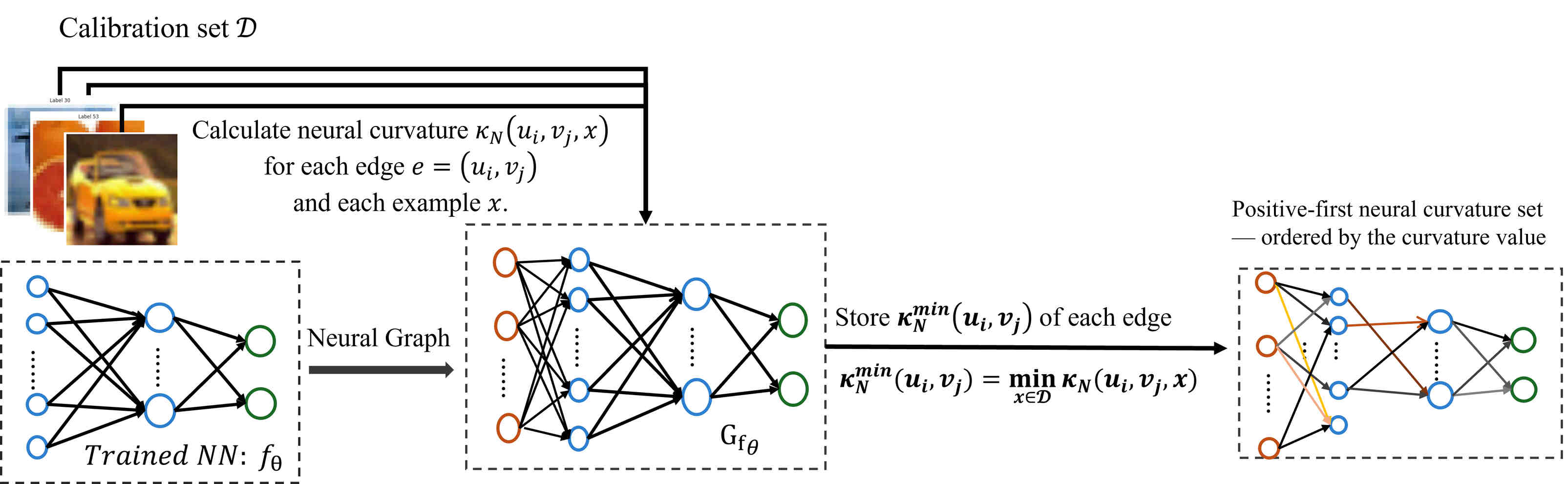
Neural networks are often treated as black boxes, making it difficult to understand how their internal structure shapes their behavior. I use graph theory and geometry to analyze them as directed graphs that capture information flow, then apply Ricci curvature to identify structural bottlenecks and study two practical questions: which connections can be pruned, and which bottlenecks are associated with fragile predictions?
The graph-curvature pruning pipeline: from a trained network and calibration data to an ordering of neural connections. View full-size figure
Pruning: Post-Training Neural Network Pruning Using Graph Curvature
TMLR 2026
An interpretable post-training pruning method that identifies important information flows and structurally redundant connections using graph Ricci curvature. I accelerated the shortest-path stage of curvature computation on GPU using dynamic programming and matrix-based operations. I also extended the framework to Llama 3 and IBM Granite by constructing graph representations of transformer information flow for model analysis and pruning.
Robustness: Analyzing Neural Network Robustness Using Graph Curvature
ICAA 2024
I introduce neural data graphs and neural Ricci curvature to identify structural bottlenecks associated with model robustness. Less robust predictions exhibit stronger bottleneck structures, providing a graph-based explanation of model vulnerability.
I am exploring KV cache eviction and memory management for language models operating over long contexts and extended interactions. I am interested in how to decide which cached information to retain, when to evict it, and how to allocate limited memory as context grows. The goal is to balance memory use and inference efficiency with the ability to preserve information needed later in a task.
Autonomous driving · IET Intelligent Transport Systems 2024
RCP-RF: Road-Car-Pedestrian Risk Assessment
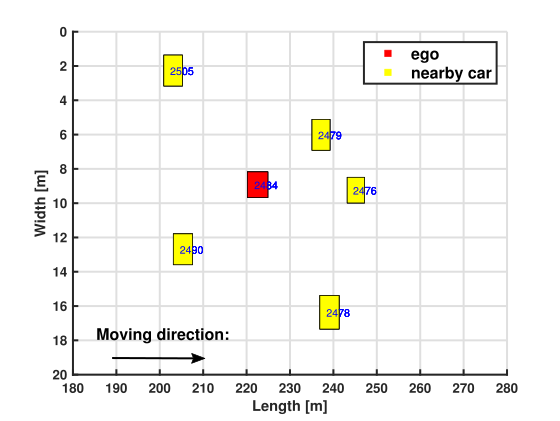
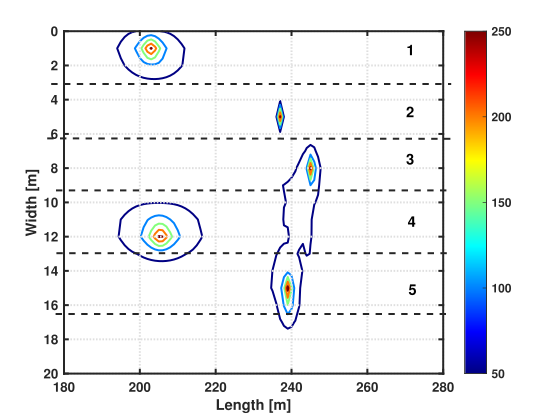
A driving risk potential field that jointly models road geometry, lane boundaries, vehicles, and pedestrians. This framework combines the surrounding traffic scene with relative-motion estimates to assess driving risk.
Traffic scene: the ego vehicle and nearby vehicles. Enlarge figureDriving-risk contours across the road. Enlarge figure
February 2022 – January 2023 · Startup–lab collaboration
Perception Research Engineer · Shineauto
I developed and deployed C++/Python LiDAR perception pipelines for autonomous driving, including point-cloud clustering and 3D bounding-box estimation for real-time inference.
I integrated 3D non-maximum suppression into a Scanline clustering pipeline and deployed Voxel-RCNN on a real autonomous vehicle using ROS for on-road data collection and system testing.
July – September 2022 · Shanghai, China
Technology Intern · Morgan Stanley
I developed an internal trade-data management platform using Angular, TypeScript, Java, and SQL to support data querying, validation, revision, and record management.
My work included frontend tools for data filtering, inspection, and ID-mapping visualization, along with backend modules for database access and validation.
Education
Rensselaer Polytechnic Institute
Ph.D. in Computer Science 2023 – present · Expected April 2028
University of Science and Technology of China
Master of Computer Technology 2020 – 2023
China University of Mining and Technology
Bachelor of Electrical Engineering and Automation 2016 – 2020
University of Wisconsin–Madison
Exchange Program in Electrical Engineering 2017 – 2018
Teaching
Teaching assistant, Rensselaer Polytechnic Institute
Advanced Operating Systems
Fall 2026
Foundations of Computer Science
Spring 2024, Spring 2026
Data Structures
Fall 2023
Reviewing
Conferences
Association for the Advancement of Artificial Intelligence (AAAI)
2026, 2027
International Conference on Learning Representations (ICLR)
2027
International Conference on Cyber-Physical Systems (ICCPS)